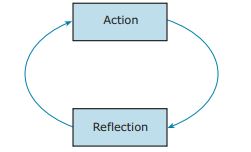
Reflective learning is where you undertake an analysis of a thought process leading to an action, you reflect on the different outcomes of the thought process and how this could be improved leading to a different action, you then compare both actions to see if an improvement has been made.(Ramsay, 2006). This is called a cycle of inquiry (shown in Figure 6).
Brockbank et al (2017) mentions that reflective learning leads to improvement and transformation, but the outcome of the learning process depends on wider external factors like social and political issues. These are known as Critical incidents, where an event causes a change in the way you work (Ramsay,2006).
For example: the thought process when I re-evaluated my decision to do my project on Hypebae instead of Hypebeast after reflection upon the article ideas I had would suit Hypebae’s page more.
Ramsay,C. (2006) Introducing Reflective learning. United Kingdom: Thanet Press Limited.
Brockbank, A., McGill, I., Beech, Nic. eds (2002) Reflective Learning in Practice. New York: Routledge.
 Paris Thomas - Critical Journal Blog